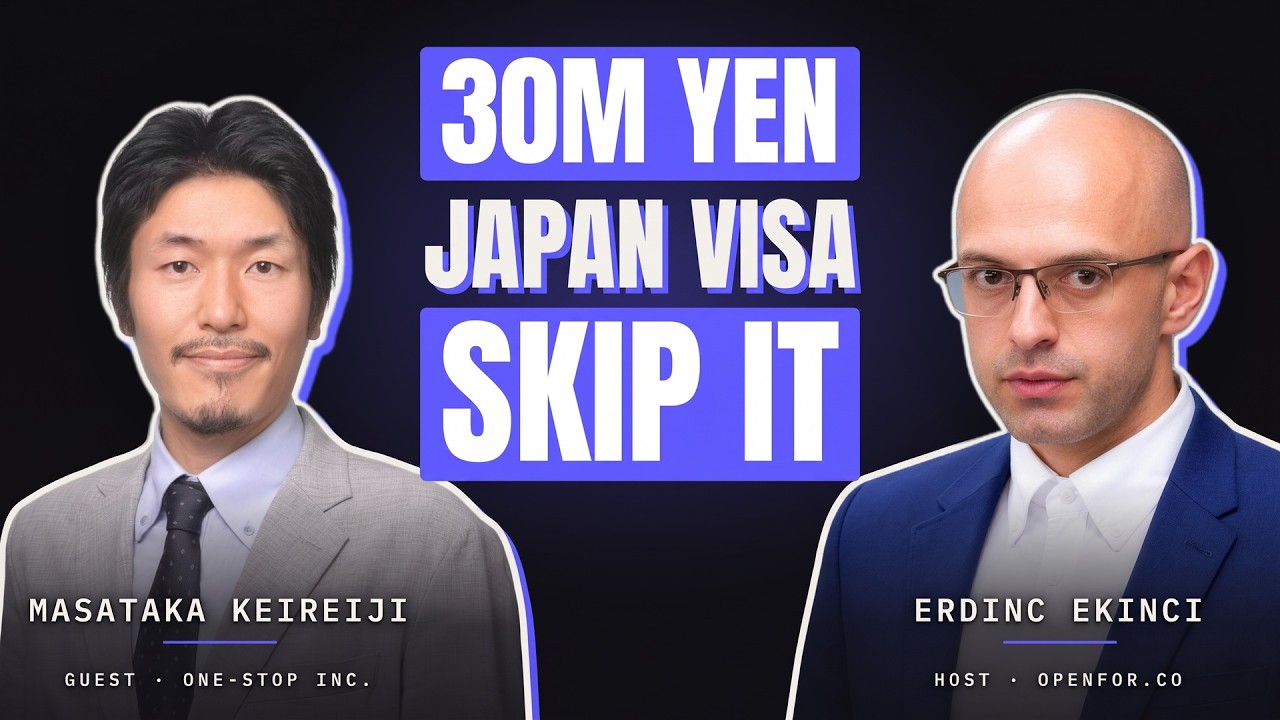
In October 2025 Japan made its business manager visa six times more expensive, and most foreign founders read it as the country shutting them out.
The man I spent an hour with helps founders set up in Japan every week, and he barely talks about that visa. Not because he found a loophole, but because he thinks almost everyone is solving the wrong problem.
Masataka Keireiji, Masa to everyone who works with him, spent 18 years in consulting at PwC and Deloitte. He ran Deloitte's venture department. He led the project team behind SusHi Tech Tokyo, first known as City-Tech.Tokyo and now one of Asia's largest startup conferences. He says he meets over a thousand startups a year. Today he runs One-stop Inc., bringing foreign companies into the Japanese market.
So when he says the visa was never the real barrier, it is worth stopping to listen. Here is what I took away.
Watch the full conversation
Jump to a section:
- 0:00 Japan changed the rules
- 1:24 What actually changed
- 6:26 Why Japan at all
- 8:24 The other door: remote market entry
- 12:56 Banks and pitfalls
- 16:52 Three cases, and GK or KK
- 22:50 Who really fits Japan
- 26:16 How to actually sell here
- 27:48 The tier game: Japan's support, rated S to F
- 36:45 True or false
- 40:38 Your next step
The rule did not get stricter. It got six times more expensive.
Before October 2025, getting a business manager visa was, in Masa's words, "super easy" for foreign founders. The capital requirement was 5 million yen.
Now it is 30 million, roughly 200,000 US dollars. And the money is only the first of five conditions. You also have to hire one full-time member of staff in Japan, clear a Japanese language requirement, have your business plan reviewed by a Japanese professional, and show three years of management experience or a qualifying degree.
"Most of the foreign entrepreneurs, it's not affordable," he said.
He reckons roughly 95% of people who were considering an application simply stopped. That figure is his own estimate from what he sees, not a published statistic, so treat it as the shape of the drop rather than the number.
The part nobody discusses is what happens to founders who are already here. When their visa comes up for renewal, they meet the new conditions too. Some of them will have to leave a business they have already built.
The visa was never what Japanese buyers were checking
Here is the reframe that made me rethink the whole conversation.
Founders assume the visa is the gate. It is not. The gate is a question a Japanese corporate asks in the second or third meeting, and Masa quoted it almost word for word:
"Hey, you have a Japanese company or you have Japan corporate bank account?"
Nobody asks about your residence status. They ask whether you have an entity here and a bank account here, because in Japan, as he put it, "we go with trust basis way." The entity is not paperwork. It is the cheapest proof of commitment you can buy.
I have been selling cross-border into Japan for fifteen years and I have watched this kill deals that were otherwise done. The product was fine. The pitch was fine. The buyer went quiet because there was nothing on this side of the ocean to point at.
So the real question was never "how do I get a visa." It was "how do I get an entity and a bank account." Those turn out to be different problems with very different price tags.
There is a second door. No visa, no travel, no paper.
One-stop Inc. calls it remote market entry. Masa calls it the visa-free way, and the company's tagline is three words: "No visa, no travel, no paper."
The company is set up in Japan, 100% owned by the founder. No Japanese partner is required, no nominee, no local shareholder. And because nobody is applying for a visa, the five conditions stop applying at all.
No 30 million yen. No mandatory hire. No language test. No business plan review. No management history.
"You can forget of five condition at all," he said.
You also do not have to move, and you do not have to visit. The whole setup runs remotely and mostly paperless. One-stop runs nine services in total: incorporation, corporate bank account, accounting and tax and labour setup, market research, business development, licence applications, hiring, fundraising and M&A.
I have had founders in Openfor.co and in the Founder Institute chapters ask me how to expand into Japan for years, and honestly I never had a clean answer. This is the first one I have heard that does not start with "first, move here."
The bank account is the real wall
Incorporation is the easy half. The bank is where foreign founders get stuck, and Masa was blunt about why.
Banks do not want the risk. Anti-money-laundering rules make them cautious about anyone they cannot easily verify, and "the most unknown people from the Japanese bank is a foreign entrepreneur living abroad."
He has lived it himself. When he applied for a corporate account for his own company at one of the megabanks, the website said startup friendly. He was rejected. His read: they want startups that already have a track record with another bank. "They don't want the customer from the beginning of their business."
Another megabank has since launched a genuinely founder-friendly service. He checked. It is built for Japanese founders, not foreign ones.
So One-stop solved it by taking the risk itself. The company has an arrangement with a bank and puts its own name down as guarantor for its clients, which is why it runs proper KYC and background checks before accepting anyone. Start to finish, incorporation and bank account together take about a month and a half, sometimes one month.
Three things stop you before you start, and none of them are money
Ask what actually blocks a foreign founder doing this alone and you get three answers, all boring, all fatal.
- An office address. Landlords and office providers are reluctant to rent to a foreign resident company with no local presence, and you cannot register without an address.
- A registered personal seal. Japan runs on stamp culture. Residents register a personal seal with their local government and use it on registration documents. If you are not resident, you do not have one.
- A personal Japanese bank account. At incorporation, the initial capital has to be paid into a founding director's personal account in Japan. Most foreign founders do not have one, and cannot easily open one.
None of these are about whether your business is good. They are the kind of problem that quietly ends an expansion plan, and most people never hear about them until they are already committed.
GK or KK is a smaller decision than founders think
This is the question Masa gets constantly, so we did it properly.
GK is the Japanese LLC. KK is the corporation, closer to a US Inc. The practical difference is one thing: only a KK can take outside investment into the Japanese entity, and only a KK goes on to an IPO here.
Most foreign companies set up the Japanese entity as a wholly owned subsidiary of the parent. There is no local funding round coming. In that case GK is fine, and cheaper.
If you expect to raise into the Japanese company or list here, go KK. And if you start as a GK and change your mind, you can convert later.
The one real argument for KK is optics. To a large Japanese corporate a KK simply reads as a bigger company. I asked whether the corporates actually check. His answer was no, not really. That is worth knowing before anyone pays extra for the badge.
Japan does not need your product. It needs your proof.
He was clear about who should not come. If you do not have real technology and a track record in your own market, Japan is not the fix. This is a tech-advanced country with demanding buyers, and arriving without proof means burning money slowly.
Who fits: B2C businesses that want a large, stable, high-spending population. B2B companies that can survive a long sales cycle, because once a Japanese corporate signs, contracts tend to be long and stable.
He named two sectors with real pull right now. Property tech, because the big group companies in rail and real estate own enormous portfolios and are actively looking. And robotics, AI and factory automation, because Japan still manufactures at scale and those factories want their processes streamlined. He was deliberately careful about fintech and health, where the rules change country by country.
His advice on what to bring was the part I would underline. Japan-specific sales material. A genuinely good business development person on the ground. And ideally an English-speaking Japanese person, not a Japanese-speaking foreigner. Those are not the same thing and the difference shows up in the room.
Tokyo is rated S. People like me got a C.
I made him rate Japan's support system from S to F, and he did not soften it.
The Tokyo Metropolitan Government got an S. Biggest budget, the most startup programmes, genuinely friendly to foreign founders. His sharpest point: when government bodies assess a company for tenders and subsidies, they generally check where it is registered, not who owns it. Register in Tokyo and you are largely treated as a Tokyo company. For a foreign founder that is a bigger opening than most people realise.
JETRO got a B. Good unified information, but at the point of detail he finds they tend to hand you on to another organisation.
Osaka got an A, Tokyo first among the cities, with Fukuoka close behind and popular with Taiwanese founders for being near home and pleasant to live in. He thinks Tokyo still wins on business opportunity because every industry and every large corporate is here.
Then I asked about accelerators and incubators, which is my own world. He laughed and said he thought he was about to get roasted publicly.
He gave them a C.
His reasoning: he is not sure what they are actually delivering beyond mentorship. If a programme could put real sales or a paid pilot with a Japanese corporate in front of a founder, that would be the thing that matters, and he knows how hard it is, because it takes the kind of relationships 18 years in consulting builds.
I am not going to argue with the C. I run programmes, and he is pointing at the gap I spend most of my time trying to close. Mentorship is easy to supply. Revenue is not.
You cannot sell your way in before you commit
We ended where every founder wants to start: can I just get a customer first, then set up?
Almost always no. Masa tells clients to incorporate first, because the entity is what unlocks the conversation rather than the other way round. He called it a chicken-and-egg problem, where people try to get the meat first.
That is the whole argument of the hour. The 30 million yen is a wall in front of one door. The door next to it asks for commitment instead of capital, and commitment in Japan has a specific shape: a company here, a bank account here, a face here.
"Once you make an entity, you have a trust, and easy to get the bigger business."
The money was never the hard part. Deciding you are serious is.
Watch the full session
This is the short version. The full conversation runs just over 42 minutes and ends with a rapid true or false round, including whether Japan actually wants foreign founders at all.
Watch the full episode on YouTube
Subscribe for more conversations with the founders, investors and operators building globally.
About One-stop Inc.: Tokyo-based market entry firm founded by Masataka Keireiji. It takes foreign companies into Japan end to end, from incorporation and corporate banking to hiring, fundraising and M&A, including a remote, visa-free setup route. one-stop-inc.com
About Openfor.co: Building alone? No team, no mentors, no audience, no one keeping you accountable. With a simple Openfor.co membership you get a whole company behind you: AI agents that do the work, mentors who review it with you every week, your own audience and distribution channel built around what you make, and a global community to test with, sell to and build with. openfor.co
This episode includes paid promotion for One-stop Inc.
This post is for education only and reflects the personal views of the speakers. It is not financial, legal or investment advice.