Why Robotics Founders Are Still Solving a 2016 Problem
Most robotics founders I meet are working very hard on the thing that stopped being hard.
The investor I just spent an hour with sees hundreds of these companies a year, and she says the same thing happens to almost all of them. They get stuck at seed with a prototype they are proud of and no customer who pays. After listening to her reasoning, I think the problem is not the engineering at all.
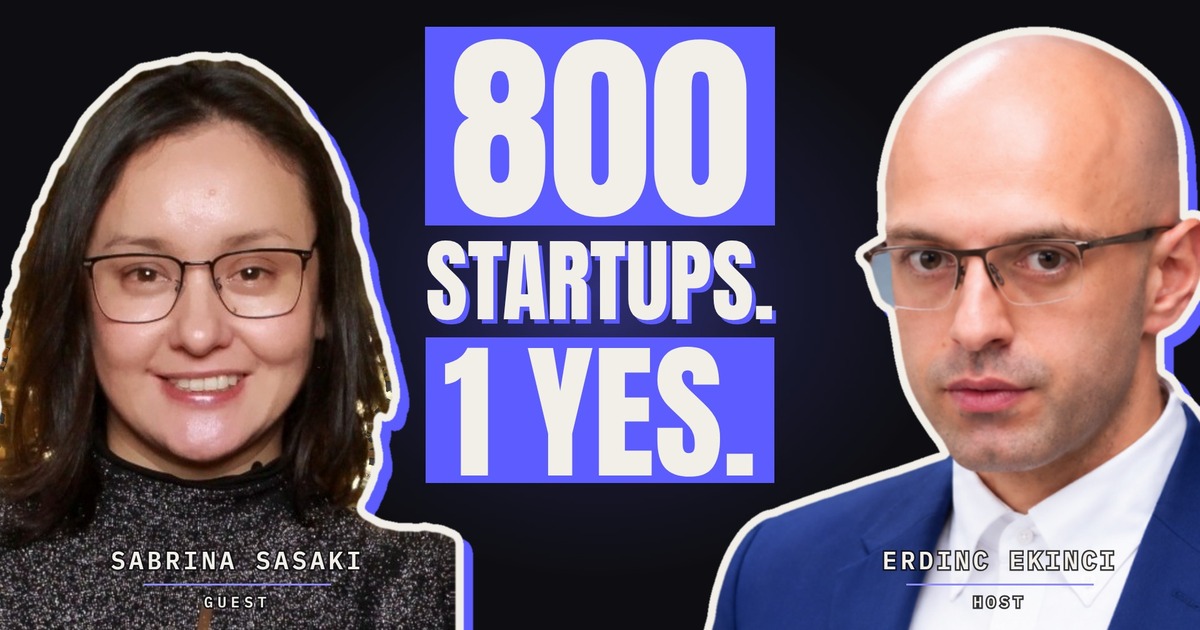
Sabrina Sasaki was born and raised in São Paulo. Her mother is Brazilian, her father was Japanese. She moved into hardware through Makers Bootcamp, an accelerator in Kyoto, and today she invests through Monozukuri Ventures, one of very few Japanese seed firms with an office in the US that actually writes cheques into American companies. Her portfolio includes Earth Grid, which bores tunnels with plasma, and Seasats, whose autonomous solar vessel crossed the Pacific from California to Japan.
So when she says the bottleneck moved, it is worth stopping to listen. Here is what I took away.
Watch the full conversation
Jump to a section:
- 1:26 São Paulo to Kyoto
- 6:24 Why VCs are wrong about hardware
- 7:20 What physical AI really means
- 14:47 The pilot trap
- 20:21 Seven years. Nothing happened.
- 25:28 25,000 names and mistake number one
- 30:20 What VCs are tired of seeing
- 32:24 Humanoids: hype or not
- 37:50 Why you win local first
The prototype stopped being the hard part. Nobody told the founders.
Ten years ago, building a physical prototype was the wall. Tooling was expensive, suppliers were far away, and the whole playbook was "go to China, everything there is cheap and quick."
That wall is gone.
"Prototyping is no longer the main concern," Sabrina said. "I've seen most robotics companies stuck at seed stage. They have some sort of prototype. They think it's ready, and their customers are still not paying."
Read that again, because it is the whole episode in one sentence. The prototype is finished and nobody is buying.
What she sees instead is founders still running the Kickstarter playbook from the maker movement, optimising a demo for an audience of engineers while the actual buyer never enters the room.
I told her VCs avoid hardware. She stopped me.
I said what I hear constantly: most funds deliberately stay away from hardware and manufacturing.
"I disagree. I see more and more funds who are agnostic, investing more and more in deep tech, because the real opportunities with physical AI and automation are in connecting software and AI to physical environments. So I totally disagree with you on that."
She is right and I was repeating something that was true a decade ago. The money has moved, and it moved for a reason she explains better than most people in the space.
Physical AI, stripped of the buzzword, means bringing AI to anything with a body or a location: machines, infrastructure, logistics, energy systems. And the part people skip is energy. "Energy is no longer a cool sustainable discussion. It is a national security and supply chain resilience question."
That reframing matters. When something becomes a security question, the budget stops being discretionary. Governments write the frameworks, corporates get tax incentives, and capital follows. That is not a trend, that is policy.
One of her examples made the point concrete. Earth Grid uses plasma boring to install power lines, fibre and pipelines underground. Why does that matter? Because, as she put it, the American grids are not connected to each other. If one region has a shortage, clean energy cannot be moved there. You cannot run an AI revolution on a grid that cannot move power.
A pilot is not a customer. It is a free sample.
This is the trap, and it is specific enough that founders should check themselves against it today.
A large company runs a pilot. Everyone celebrates. Nothing converts.
"Those large companies have the power to get any pilot and get all those things tested internally, and they don't have any pressure to move forward."
Her second question is the one that separates a useful pilot from a wasted year: what feedback did you get that helps you serve a different customer too? If the pilot only taught you how to solve one corporate's internal problem, you did not run a pilot. You did unpaid R&D.
I see the structural version of this in Japan all the time. Large corporates here are used to tier one and tier two suppliers, so they treat a startup like an established small supplier with capital and patience. The startup has neither. As Sabrina said, startups "shouldn't become consultants or cheap R&D" for those corporates, and most of the damage happens because nobody says that out loud early enough.
Seven years of meetings. Nothing happened.
She described a portfolio company that had been in conversation with large corporates for seven or eight years since the investment. Nothing happened.
Not a rejection. Just nothing.
Her read is that founders do not understand the buying cycle they have walked into. One of the most impressive founders she ever met kept a yearly timeline of how budgets worked in each target industry, when they tested, when they decided, when the money appeared.
And when the answer is no at the moment the budget existed?
"Wait for next year? Stop. Stop wasting your time. Put that corporate into your newsletter, marketing, PR. That's it. Don't waste your time."
That is the most practical sentence in the episode. Most founders will not say it to themselves because walking away feels like losing. It is not. It is reclaiming a year.
Do not build the robot. Build what every robot needs.
Ask her what she is tired of seeing and the answer is not a technology, it is a scale of ambition pointed in the wrong direction.
"I'm tired of seeing companies that are building for the past or the current problems."
Her alternative is specific. Instead of yet another last mile delivery robot, look at what makes every last mile robot expensive. The answer, she says, is the actuator, which she calls the number one problem in robotics and in humanoids.
But even there, she wants precision, not universality. An actuator for a small robot and an actuator for a large excavator are different products, and the firm is already working with a Japanese construction company on exactly that gap.
"Be niche, be specific, and find your customer that really needs that."
This is the part founders resist most. A component business feels smaller than a robot company. It is usually a much better business, because you sell to everyone building robots instead of competing with them.
Humanoids are coming. Not on the investors' schedule.
"It will be something, soon, but not as soon as the investors want."
She is not a humanoid sceptic. She is worried about the sequence. Companies will fail quickly and loudly, and her fear is what that does to everyone else: "the damage can be very harsh on the ecosystem."
Her hedge is the same argument as above. Back the sensors, components, actuators, materials and chips that a humanoid would need, because those same parts already sell into industrial applications that exist today. Her example is EdgeCortix, a Japanese chip company whose work serves autonomous vehicles now and could serve humanoids later.
And the line underneath all of it, which I have been thinking about since: "There are two things you cannot change. Physics and chemistry."
Software founders can iterate their way out of most mistakes. Hardware founders cannot iterate their way out of a material that does not behave.
800 startups, one investment
Then the number that should be printed on every fundraising deck.
"In order to invest in one company, some funds, even deep tech robotics, will consider 400, 600, 800 startups before making one investment."
Which makes the first mistake obvious once she names it. Founders buy a database of 25,000 investors and cold message all of them. She is not against cold outreach at all. She is against lazy cold outreach.
A message that references her actual portfolio, names the thesis correctly, and says plainly why it does not compete with her existing companies will get her attention. A message built on a failed portfolio company from ten years ago tells her the sender did no homework.
Then the harder truth, the one she calls mistake number one:
"It doesn't mean that if you had a meeting with a firm, they are considering investing."
Many firms have associates whose job is to take meetings and write reports. A friendly call is not a signal. A fund that has already made its ten investments this year is not a prospect, it is a relationship for next year.
I work with a lot of deeply technical founders across Japan, Korea and Taiwan who can build nearly anything and then freeze when it is time to sell. For them this is the most useful reframe in the whole conversation: fundraising is a sales pipeline with a brutal conversion rate, and a meeting is the top of it, not the bottom.
Win the people who already know you first
Her final advice inverts what almost every founder here tries to do.
"Instead of trying to go across the world and convince someone on the opposite side of the world that your company is viable, try to find your local community."
Start at Startup Weekend. Build relationships where you already live. Get the angels and the local operators who understand your problem to back you first.
Not because local money is better money, but because of what its absence says.
"If you see a startup that is struggling to get investment from the local community, you start questioning why. Why can they not convince these people who met them, who understand the problem?"
I have watched founders fly to San Francisco to fix a credibility problem they had at home. It does not work. The plane ticket is the easy part. The people who already know you are the hard part, and that is exactly why their yes is worth something.
Watch the full session
This is the short version. The full conversation runs just over forty minutes and ends with a rapid fire round where she names nanotechnology, not quantum, as the most underrated field right now.
Watch the full episode on YouTube
Subscribe for more conversations with the founders, investors and operators building globally.
About Monozukuri Ventures: A seed stage firm born out of Kyoto, investing in hardware and robotics startups in Japan and the United States, and connecting them to Japanese prototyping and manufacturing partners. Portfolio includes Earth Grid, Seasats and EdgeCortix.
About Openfor.co: An agentic entrepreneurship incubator supporting founders, operators and professionals with Silicon Valley grade access, programming and investor relationships.