Almost everything a junior person used to do inside a venture capital firm has been automated away.
That sounds like bad news for anyone trying to get into venture. The investor I just spent an hour with thinks the opposite, and after listening to her reasoning, I think she is right. What is left after the automation is not a smaller job. It is a harder, more human one, and it happens to be the same job whether you join a fund or start your own.
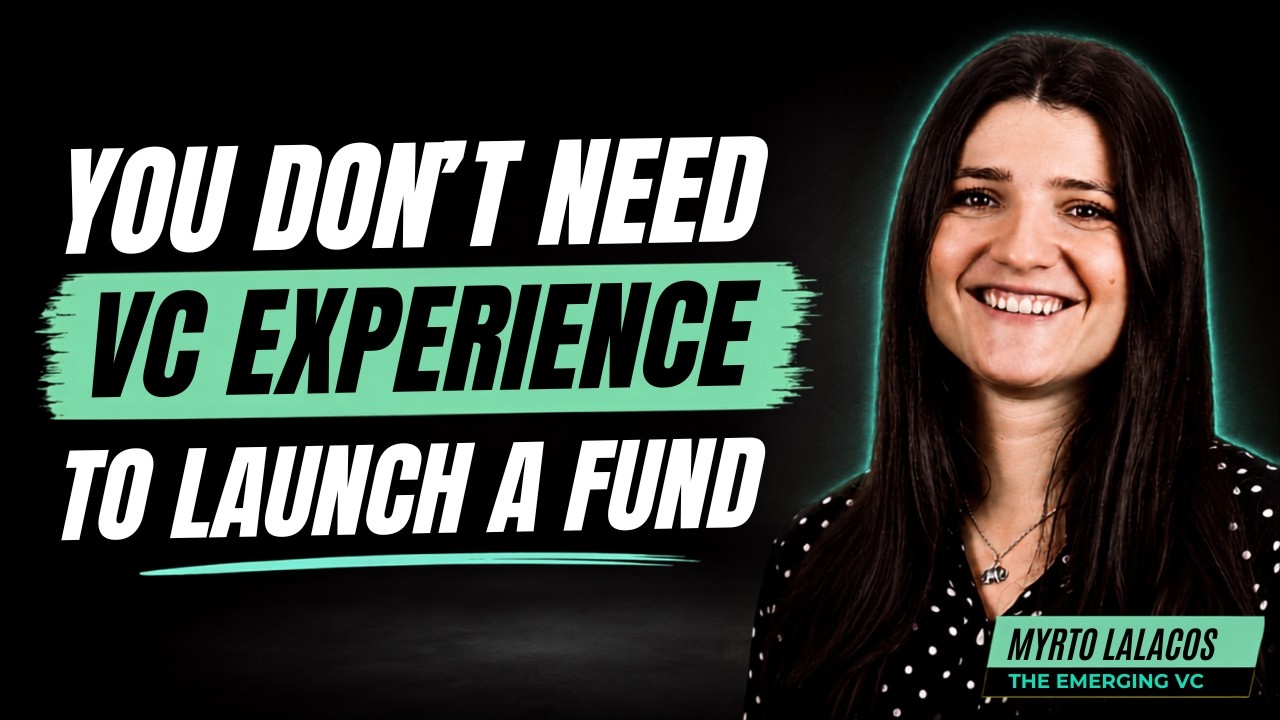
My guest was Myrto Lalacos, founder of The Emerging VC. For four years she ran the programme that launched a large share of the world's new venture firms. She has worked with hundreds of emerging managers across the world. She became one of the most active voices on LinkedIn writing about launching and investing in venture firms, which put her in direct contact with a fifth to a quarter of the world's active VC firms.
So when she says the path into venture has changed shape, it is worth stopping to listen. Here is what I took away.
Watch the full conversation
Jump to a section:
- 0:00 Why the best spreadsheet does not win
- 1:26 Who Myrto is
- 2:45 How many VC firms exist, and how fast that is changing
- 8:10 The new shape of a fund thesis
- 11:02 Why a founder should want a smaller fund
- 17:56 How AI tools now go looking for founders
- 22:05 The three jobs AI has not taken
- 26:17 What the managers who make it have in common
- 30:24 The mistake that kills a fund before it starts
- 33:15 Selling, rejection, and staying sane
The industry took seventy years to build 7,000 firms. Then it sped up.
Start with the size of the thing, because most people guess wrong.
Nobody has an exact count, but the estimate for active venture firms worldwide sits somewhere between 5,000 and 9,000. Call it 7,000. The industry started in the 1950s, so roughly seventy years produced that number. Average it out and you get about 85 new firms a year.
Then look at the last four years. Myrto helped launch at least 400 firms herself through the programme she was running, and reckons that was somewhere between half and sixty percent of all new firms formed in that window.
The run rate went from about 85 new firms a year to roughly 200.
That is a category changing shape, and it happened because the cost of launching a fund collapsed.
It used to need an anchor investor. Now it needs a point of view.
The old route was blunt. You needed one large investor to put a big cheque in first, then you raised a lot more on top of that, because forming a compliant fund and running it was expensive.
That is no longer the barrier. Service providers, tooling and back office platforms have dragged the cost down far enough that small funds are viable. A lot of what gets launched now sits under ten million dollars.
Myrto was careful about what that means for the person running it. A fund that size pays very little in management fees, and those fees are not a salary. They run the entire firm. The people doing this are taking pay cuts.
What replaced the anchor investor is specialisation. The industry moved from sector agnostic, to sector specific, to technology specific, and now to something more interesting: theses built around communities. Funds backing a particular expat community. Funds built around religious groups. Native American general partners investing in Native American founders.
She gave me a hypothetical on the spot, which I enjoyed more than I should have: I am Turkish, so I could raise a fund backing Turkish founders in Japan. Niche is the point now, not the apology.
A pilot is not access. A small fund is.
This part matters more to the founders I work with than to anyone dreaming of raising a fund, so I pushed on it.
Myrto's case for going to a smaller fund is practical. You can actually reach the decision maker. "These people are more accessible. There's less founders blowing up their DMs." Many of them still read cold pitches, because they have to.
Then there is the thesis effect. Because emerging funds are so specific about what they back, there is a reasonable chance a fund exists that was built for exactly your sector, your stage, or your founder profile. You are not persuading a generalist. You are finding the one person who already believes.
Support changes too. She mentioned Bessemer, a firm with something like 450 active startups in its portfolio. At that scale a lot of the support has to be automated, and one to one attention is structurally hard.
A new manager has the opposite incentive. They need every founder and every limited partner to give them a glowing reference, because they will be raising fund two off the back of it.
And the cheques are smaller, which sounds like a drawback until you are pre-seed. Funds that started out backing the earliest rounds grow, their cheques grow, and they quietly stop being early stage investors. The name on the door stays the same. The stage does not.
I raised the obvious problem: approachable is not the same as findable. These firms are small, often legally restricted from talking publicly about a fund they are still raising, and invisible to a normal Google search.
Her answer was not what I expected.
The cameras did not get better. The sourcing did.
More funds are now running AI tools that go out and flag founders matching their exact thesis.
The variables are not just sector and geography. "It can go down to ethnicity. It can go down to papers you published, hackathons you participated in, updates on your LinkedIn, who you connected with on Twitter." She called the level of tracking mind-blowing, and she was not being dramatic.
So the practical advice flips. Instead of hunting for invisible funds, make yourself the thing their tools pick up.
Her example was deliberately unglamorous: if you are in stealth mode, go and put stealth mode founder on your LinkedIn. If you are raising, follow and connect with investors. Leave a trail that a machine can read.
The technical founders I work with in Japan, Korea and Taiwan can build almost anything, then go quiet about it. Most cannot get past the cringe of putting themselves online. That silence used to cost them attention. Now it costs them discovery by systems built specifically to find people like them.
The three jobs AI has not taken
Here is the spine of the whole conversation.
Fund administration, back office, deal filtering, first-pass analysis, chunks of due diligence: tools and service providers now do all of it. Those were the tasks an analyst or an associate did. So firms are not hiring for them. Emerging funds, Myrto said, are almost not hiring at all.
What is left for humans is short enough to write on a napkin.
- Fundraising. Finding and closing limited partners.
- Deal sourcing and picking. Partly automated, mostly still relationships and judgment.
- Brand, as a bonus. Making sure founders know to come to you once your first network is exhausted.
Then came the line that reframed the session for me: "The customer is the limited partner. It's not the startup. It's not the founder." The founders, or rather the investments in them, are the product.
Follow that logic and the conclusion is unavoidable. For its first eight to ten years, a firm will only hire people who move one of those three needles. Which means if you want a job in venture, you need to arrive with limited partner relationships or with deal flow that fits the thesis.
And if you can raise money and source and pick deals and build a public profile, you are much closer to launching your own firm than you think.
Joining and launching have collapsed into one skill set, because everything that used to sit between them has been automated or outsourced.
Chasing the opportunity is not the same as having an edge
The most common mistake she sees is almost comically current.
Someone spent their career in fintech or climate, sees AI valuations, and decides to raise an AI fund. The question she asks is simple: what is your edge here? You have not invested in it, you have not helped companies in it, you have no particular access to those deals.
"It's people chasing an opportunity without having an advantage."
Her framing of the risk made it concrete. Venture is already one of the riskiest asset classes. Launching a new firm adds risk on top. Backing a first-time manager who is also a stranger to the sector multiplies it again. Why take that stack of risk with you rather than a fund that has been doing it for years?
What the winners have instead is an edge that matches the thesis precisely. A track record in that exact stage and sector. Real access to those deals, often from having built a community in that space for years. Or what she called the Midas touch: "whatever company you touch it turns into gold", through mentoring, go to market help, or introductions that visibly move a company forward.
And one unglamorous ingredient: the first investors in a new fund are almost always people who already know the person raising it. Not institutions. People who have watched them go from strength to strength and want in on whatever is next.
I went through that programme twice before it clicked, which is not something I enjoy admitting. I was always a bootstrapped founder, so I had never raised external money in my life, and that was a real disadvantage. What did work was the network. Fifteen years of selling across borders leaves you knowing a lot of people, and in this game that is not a soft asset.
Selling is not a soft skill here. It is the job.
I asked which human skills actually separate the people who make it.
Her first answer was flat: "Your ability to sell is huge."
The sequence is worth memorising. The thesis is day zero. "Fundraising comes at day one." Before the deck, before the data room, before the projections. You go and find out whether anyone wants what you are building.
From then until the final close, a general partner spends between 50 and 80 percent of every day fundraising. She described one manager who closed his first fund in about eighteen months to two years, having pitched more than 2,500 limited partners in his CRM. Around 30 came in.
Read that ratio again, then decide whether you are comfortable being told no.
The second skill surprised me. The best fundraisers she knows do something deliberate before an investor call: a short meditation, a mental exercise, something that reconnects them with why they are doing this, so they walk in and, in her words, "contaminate the limited partner with all their enthusiasm".
I do a version of this without ever having named it. Before any sales call I stand up, because posture changes your voice, and I do ten squats to get the blood moving. It sounds silly written down. It works.
The third thing is not a skill at all, but it is the one nobody warns you about. Most managers need two to four years where they can live on a reduced salary, or none. That requirement quietly decides who can do this and who cannot, regardless of talent.
What she is building now
Myrto's work with The Emerging VC comes from a conviction about what happens next. The access problem is largely solved: the information is out there, the tools exist, the funds are launching.
The risk now is the generation that just raised. If a wave of first-time managers gives their investors a poor experience, those investors get spooked out of the asset class, and the door that opened starts closing again. Every manager who took someone's money carries a bit of responsibility for whether the next person gets a chance.
So she curates what exists, so a manager who is great at raising but stuck on deal flow can find the thing that fixes it.
I sit on both sides of this. I host investors like Myrto, and I work with founders inside Openfor.co trying to be found by exactly these people. Both sides are now being told the same thing: the technical work is handled, now go and be visible, specific and useful to someone.
Her sharpest line was about funds, but it is not really about funds.
"If you don't have the advantage, game over."
Having no edge yet is fine. Pretending the trend is one is not.
Watch the full session
This is the short version. The full conversation runs just over 42 minutes and ends with Myrto taking questions live from founders and aspiring investors in the room.
Watch the full episode on YouTube
Subscribe for more conversations with the founders, investors and operators building globally.
About The Emerging VC: An independent resource for emerging venture capital fund managers worldwide, founded by Myrto Lalacos, curating the insights, events and tools for launching and scaling new venture firms.
About Openfor.co: AI lets one person build like a whole company. But most people still work alone: no team, no mentors, no audience and no one holding them accountable. Openfor.co gives you all four for one monthly membership. AI agents do the work, mentors review it with you every week, our channels feature it, and a global community gives you people to sell to and build with. No equity taken. Everything you make is yours. openfor.co
This post is for education only and reflects the personal views of the speakers. It is not financial, legal or investment advice.