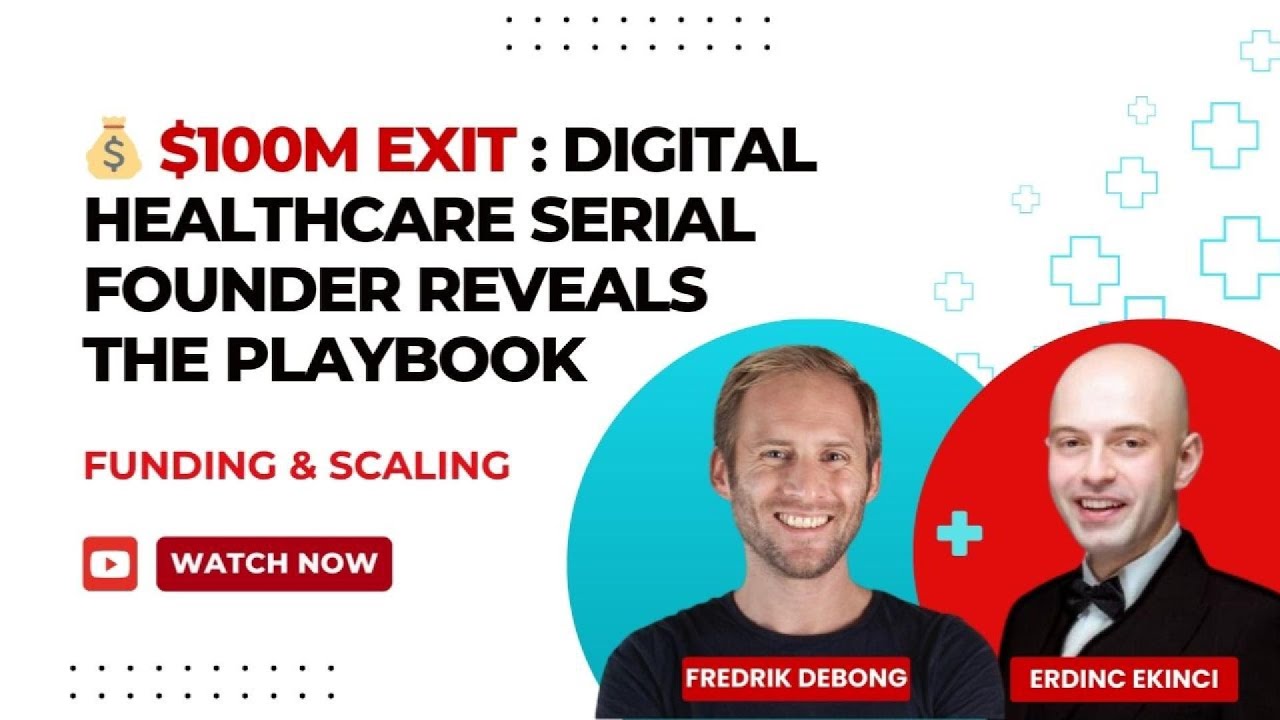
Most founders treat regulation as the reason not to build something.
The investor I just spent an hour with built three companies inside the most regulated markets there are, exited two of them, and now invests only there. He calls the rulebook a hack. After listening to him explain why, I think he is right, and I think most founders have this exactly backwards.
Fredrik Debong was diagnosed with type 1 diabetes around forty years ago. He has been writing software since he was sixteen. He co-founded pioneers.io in Vienna, then mySugr, the diabetes app that went through CE marking and the FDA, launched in 70 countries, reached four to five million users and was acquired by Roche Diagnostics in what was then the biggest digital health exit in Europe. Then he built hi.health, a payments and bank service plugged into health insurers, which now handles around half a billion a year in Germany. He has invested in more than two dozen companies. He now runs 1921, his own micro-VC, named after the year insulin was discovered.
So when he says the regulation is the opportunity rather than the obstacle, it is worth stopping to listen. Here is what I took away.
Watch the full conversation
Jump to a section:
- 03:08 Stockholm, Vienna, and a diagnosis that shaped a career
- 05:04 mySugr, 70 countries, and the Roche exit
- 11:12 From ignoring his own diabetes to building a company around it
- 13:02 Why he refused to become a generalist
- 16:30 How you scale inside a niche market
- 21:29 Regulation as the operating system of your company
- 25:32 Where a rule change creates a startup
- 28:42 What actually drives an exit
- 33:44 Entrepreneur, angel, then VC
- 45:14 Smaller cheques, same valuations
- 51:11 Why specialist funds win
He did not start by solving diabetes. He started by ignoring it.
The origin story is not the heroic one. For four years as a young adult he simply stopped managing his own condition. Seven injections a day, constant testing, doctors. He had a full-time engineering job from the age of sixteen and no appetite for any of it.
What pulled him back was not willpower. It was design.
While studying medical computer science, game design and psychology at the same time, he started hacking his own behaviour, rewarding himself for testing his blood glucose once a day. It worked. Then came the obvious question: why is nobody working on the psychology of this?
That question became a company. The product did not make diabetes go away. It made the therapy bearable and the data useful in daily life, which turned out to be the part nobody had built.
He deliberately refused to become a generalist with one deep skill
There is a standard shape people aim for: shallow knowledge across many things, deep expertise in one. He did not want it.
"Where does innovation happen? Where does the creation of new things happen? It's when you have deep expertise that connects somehow."
Psychology, medicine, computer science and game design were four separate depths, and mySugr lived at the intersection of all of them. His point is that the intersection is where new things get built, not the single spike.
This is the part I would push back on slightly, except that his own career keeps proving it. He describes himself as a jack of all trades and master of some, and then as a total specialist in how he invests today. Both are true. The broad base is what lets him see the opportunity. The narrow focus is what lets him add value once he is in.
The niche is not the ceiling. It is the entry point.
Founders in a narrow market get told constantly that the market is too small. Investors say it. I hear it in every program I run.
Type 1 diabetes affects somewhere between 10 and 20 million people, with annual spending on the therapy in the range of 15 to 20 billion. That is not small, and it is also under-counted. He sits on the board of a hospital in Bangladesh where there is no reliable reporting on how many people have type 1, because people die before they are treated.
When he breaks his own investment thesis into an addressable market, including the conditions that actually kill people with type 1, cardiac, kidney, liver and neurological, it runs to hundreds of billions and keeps growing.
His framing on market size is blunt and worth repeating: "Facebook for cats is probably going to work. There's a shitload of cats. Yeah, sure. But do they have money?"
Finding a big enough market is basic homework. The interesting work starts after that.
mySugr did not scale by selling harder. It scaled by changing who pays.
The growth did not come from a better funnel. It came from tapping two waves, mobile and data, and then getting the service reimbursed, which means insurers started paying for it.
His test for any health company is three questions in sequence. Can society, through insurers or health plans, pay for this? Are you generating enough value and reducing enough risk in the population that it matters? And can you capture a piece of the value you create and turn it into money?
If you cannot answer all three, you do not have a scaling problem. You have a business model problem.
The real scaling challenge is not the market. It is the org chart.
He was more interested in a different kind of scaling, and he turned the question back on me: two people to 10 to 30 to 50 to 100 to 200.
I see this constantly. The highest headcount in our current portfolio is 25, and the breaks are predictable. Around 10 the founder stops doing everything and delegation starts. Around 50 the thing becomes an institution, with managers and chiefs and processes that did not exist the week before. Most companies I work with stall at one of those edges, and the healthcare ones struggle more than anyone, because they carry regulatory risk on top of market risk.
Which is exactly where his argument lands.
Compliance is not paperwork. It is the operating system of the company.
Read ISO 13485 or 62304 cold and you want to quit. He knows. He lectures on this at universities and still describes the first read as pure dread.
Then he explains what is actually underneath it. These documents are written by lawyers based on input from engineers who have been around too long, which is why agile practice took about 25 years to show up in regulatory environments. Behind the language are basic ideas: how to build software properly, where to look for risk, how to control for it.
"It's about taking responsibility for the safety of people. And then you read it with those goggles and you see, all right, this is a description based on amazing amounts of experience and then expressed in a way which lawyers like to read."
Once you take the principles instead of the footnotes, something useful happens. The regulatory environment forces quality management across the whole company, HR, finance, engineering, all of it. You find out what is broken early, and you already have an established process for fixing it.
"By law, you have to focus on it and get it done. It's actually kind of a hack, because it makes it simpler to scale from 10 to 15 to 200, because you have a system."
That is the inversion. The thing founders avoid is the thing that makes the hard part of scaling survivable.
A rule change is a startup waiting to be built
If regulation is the system, then a change in regulation is the opening.
"One of the biggest drivers of big change in society, and especially for startups because it creates opportunity, is a change in legal and regulatory frameworks."
Europe now has a framework for building and deploying AI models as products in healthcare and finance. That is a rulebook, and a rulebook you understand before anyone else is an advantage. Meanwhile the current US administration is pushing deregulation, which he reads as the same kind of opening from the opposite direction.
He is also honest about where the venture money does not go. A consultancy that replaces 70 percent of its manpower with AI is a real business. It is usually not a venture business.
Exits are not sold. They are matched.
He has had two exits, and he is careful to say he was deeply involved in only one of them.
What drove the mySugr acquisition was not a process. It was a change in Roche's own economics. Reimbursement meant they no longer had to haggle with insurers over the price of a test strip every year, because it was bundled into the service. Their problem was diminishing margins and the service removed the problem.
"Unless you know the right people and click with them in the right way, it's going to be hard to have an exit."
Other shapes exist. He describes a friend selling to Adidas where the whole conversation came down to what a user is worth: 250 million users, one euro each, a 250 million exit. Acquisitions as a growth hack for companies too big to grow organically, as he puts it, a growth hack for the big boys and girls.
Either way, you have to be in the room long enough for the match to be obvious. That is an argument for specialisation too.
Angel investing is your money. Venture is somebody else's.
This is the distinction he says took him a while to understand, and it is the part founders routinely get wrong about their own investors.
As an angel, you put money in, you help when asked, and then you step back. His line on this is the cleanest version I have heard: "If you do not trust the founder, don't be an angel. If you have trust issues, don't invest."
As a VC, the job changes shape entirely. You are an investment manager making money for limited partners who backed you for three reasons: they trust your thesis, they want exposure to your field, and they want returns.
"VCs are fundraising 80 percent of the time and investing 20 percent of the time."
If you have ever wondered why an investor went quiet on you, there it is.
The cheques are getting smaller. The valuations are not.
One engineer in his portfolio is doing the work of fifteen. He does not think this stays contained inside startups, and he is direct about where it goes: large organisations cutting middle management and engineering hard, and smaller companies forced to follow to stay competitive.
For venture, the arithmetic changes fast. "The seed round three years ago, nine million to achieve X. Now it's going to be like a million to achieve 2X."
I asked the question I have been chewing on for months: does that make companies cheaper?
His answer was no, and the reasoning is clean. Valuation comes from revenue, progress, market size and the share you can take. None of those drop because you need less cash. So a founder playing it right raises a smaller amount, or sells less equity, at the same valuation.
"You don't need that much money, you're just worth a million. You just need 100k, but you're worth 20 million still, based on your revenues and growth."
It becomes a founder's market. And it breaks the generalist model, because a fund sitting on 1.5 billion now has to write 1,500 cheques instead of 150.
In that market, a generalist is just access to cash
This was the sharpest strategic point of the session, and it matches what I am watching happen around me.
Traditional funds are increasingly backing emerging managers. Pre-seed used to be friends and family money. Now it is institutional, and a lot of that capital is going to small, highly specialised, often solo GPs with 20 to 50 company portfolios, specialised by vertical or sometimes by community.
His read on why that works: "Specialists are going to have the best returns, because the value add of a specialist can speed up and accelerate the startup far better than a generalist."
And for the giant generalist fund, the logical move is not to compete. It is to invest in the specialists, then write the big cheque at Series B once those companies mature.
Every piece of this session points the same way. Narrow beats broad, whether you are picking a disease, a rulebook, or a portfolio.
The advice that had nothing to do with money
I asked for one piece of advice for founders and one for investors. Both answers went somewhere else.
For founders: "Don't be in it just for the money, because then you could be selling drugs at the corner instead." Then something I did not expect from a man this deep in regulatory frameworks, which is to get your family behind you before you start, because you are going to be busy and you will need the people around you.
For investors, the question he leaves you with: "Society is changing, and in some aspects is moving in the wrong direction. Is this aligned with the value that you represent and the stories you wish to tell your children?"
He is saying something simple underneath all of it. The rules exist because what we build can hurt people. Take them seriously and they become your advantage. Treat them as an obstacle and you were never going to build in that market anyway.
Watch the full session
This is the short version. The full conversation runs just under an hour and ends with his advice to both founders and investors, which is the sharpest part of the whole session.
Watch the full episode on YouTube
Subscribe for more conversations with the founders, investors and operators building globally.
About 1921: A highly specialised micro-VC founded by Fredrik Debong, investing at seed stage in type 1 diabetes and the chronic conditions connected to it, with a European focus and cross-border investments. Named after the year insulin was discovered.
About Openfor.co: AI lets one person build like a whole company. But most people still work alone: no team, no mentors, no audience and no one holding them accountable. Openfor.co gives you all four for one monthly membership. AI agents do the work, mentors review it with you every week, our channels feature it, and a global community gives you people to sell to and build with. No equity taken. Everything you make is yours. openfor.co
This post is for education only and reflects the personal views of the speakers. It is not financial, legal or investment advice.