Most founders treat a venture round like a scoreboard. Raise, and you made it. Do not raise, and something is wrong with you.
The investor I spent an hour with runs a fund for a living, and he spent most of that hour explaining why most founders should probably not take his money. After listening to his reasoning, I think he is right.
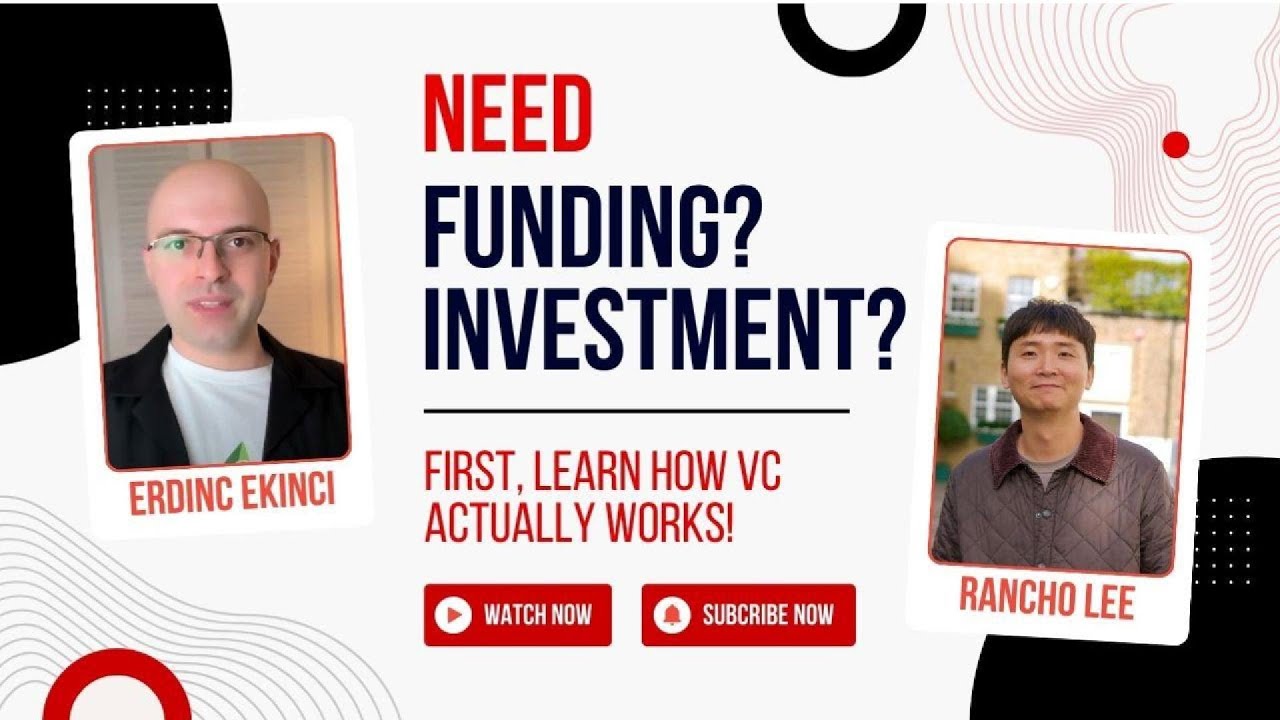
Rancho Lee is co-founder and APAC partner at Simsan Ventures, a London-based early-stage fund investing across Europe and Asia Pacific. They write cheques from pre-seed to Series A, with a preference for fintech and deep tech. The fund was built around a specific frustration: in venture, the same profile keeps getting funded over and over, and Rancho is based in Seoul rather than in one of the usual rooms.
So when a man whose entire job is deploying capital tells you that capital is the wrong goal, it is worth stopping to listen. Here is what I took away.
Watch the full conversation
Jump to a section:
- 00:00 Why only startups actually innovate
- 06:13 Why he backs founders who do not fit the profile
- 09:40 What a VC actually does all day
- 12:17 How to pick the right investor, not the best one
- 16:34 How a fund actually makes its money
- 18:35 Why a great business still gets a no
- 23:24 Risk, portfolios and the one winner that pays for everything
- 31:10 What they look for in a founder
- 35:07 The process and why it takes six months
- 41:36 What happens when it all fails
Funding is not a milestone. It is one source of money among several.
This was the line that made me stop writing notes.
"Some startups are getting confused that getting funding from a VC is a sign of success. It has nothing to do with that."
He said it twice in different ways. You are successful when you make revenue and profit. Funding is just one way of paying for the journey, and not the most common one. Most new companies never raise a round and never needed to.
I see the damage of the opposite belief constantly. Founders delay launching, delay selling, delay hiring, all while waiting for a term sheet that was never coming, when they could have had paying customers in the same three months.
A fund is not a rich person. It is someone managing other people's money.
If you do not understand where the money comes from, every investor decision will look personal. It is not.
"Basically we are fund managers. We manage other people's money."
Rancho walked through it plainly. The fund raises from limited partners. The fund managers are the general partners. On a ten million fund, roughly two percent a year covers salaries, operations and travel. When an investment exits, about twenty percent of the profit stays with the fund and eighty percent goes back to the investors who put the money in.
Read that again and a lot of investor behaviour stops being mysterious. They are not being difficult. They have their own investors, their own promises and their own clock.
The clock is the part nobody explains to founders.
A fund has a lifespan. Roughly four years to invest, roughly four years to harvest. That window decides what they can back.
"If we cannot see the possibility of getting an exit, we cannot make the investment."
Here is the part that stings. How much money your company makes is almost beside the point. A fund only gets paid when it sells its shares, through an acquisition or an IPO. A business that will be excellent in twelve years is a bad fit for a fund that has to return capital in eight.
So a no often means your timeline and their timeline do not overlap. That is a calendar problem, not a verdict on your company.
More than half of the job is meeting people.
I asked what an average day looks like, expecting spreadsheets.
"More than fifty percent of my job would be meeting people."
The rest is roughly thirty to forty percent analysis, due diligence and investment memos, and the remainder is email and admin. In London, he said, the job is closer to a lawyer's than an analyst's, because the only way to find the right founder is to be in rooms with them.
This matters enormously for the founders I work with across Japan, Korea and Taiwan. They can build almost anything, and then freeze the moment the work requires talking to a stranger. After fifteen years selling across borders here, I will say it bluntly: the relationship work is not the soft part of fundraising. It is the job.
There is no better investor. There is only the right one.
Founders ask constantly whether a strategic investor beats a financial one. Rancho's answer was refreshingly impatient.
"That is a very dumb question. There is no such thing."
A financial investor wants a return. A strategic investor, usually a corporate, wants synergy as well. First-time founders assume the strategic one is better because you appear to get more than money. Sometimes true. Sometimes the opposite.
His warning was specific. A very large corporation investing very early can end up dominating your company, absorbing your technology into theirs. At the earliest stage, he would be cautious about taking that money at all.
His practical advice costs nothing: read the investor's website before you take the meeting. Their stage, sector and taste are published. Stop spending your scarcest resource pitching people who were never going to say yes.
One winner pays for everything. That is why they need a big market.
This is the mathematics behind every frustrating no.
A fund might back ten to fifty companies knowing most will not work. If ten fail, five do fine and one goes enormous, the fund still returns. Rancho's example: invest at a one million valuation for ten percent, and if that company reaches a billion, that single position covers the entire portfolio.
"Getting one winner is more important than getting ten medium-scale startups."
Which is why they keep asking about market size. It is not a judgment that your market is uninteresting. It is that a modest market cannot produce the one outcome their model requires.
And one correction to a common founder belief, straight from him: they are not hunting technology. They are hunting a business model that technology makes possible.
"Technology doesn't make revenue themselves."
Everything about your company can change except you.
At pre-seed there is often no product, sometimes not even a company. So what exactly is being funded?
"Everything can be changed. Market, business model, technology, team members. There is only one thing that cannot be changed, which is the founder."
He was clear that this is not about degrees or brand-name employers, which help but decide nothing. The pattern he sees in good founders is consistency and grit, and he claims he can feel the difference within a meeting. Not outgoing versus introverted. Something closer to whether you will still be here in two years.
Six months is not slow. It is them watching you grow.
The process is three months minimum, up to six. Meeting, internal due diligence, a second meeting to close gaps, investment committee, contract.
But the timeline is not only bureaucracy. At the early stage he deliberately wants to watch you over time, and his reason was the best analogy in the conversation. A fifty-year-old and a fifty-one-year-old are the same person. A three-year-old and a four-year-old are not remotely the same. Early-stage founders change that fast, and he wants to see which direction you are moving.
One practical note that saves a lot of disappointment: nobody decides at a demo day. Pitch events are contact points, not decision points.
Traction is not one number. It is proof shaped like your industry.
For software, numbers. For deep tech, evidence of market pull: a signed contract, a paid proof of concept, a technical milestone hit.
"If you reach Series A and you still don't make revenue at all, you are not doing your job."
I added one thing from my own side of the table. I have watched founders with no product at all secure serious contracts inside three months, because a large company with an expensive problem will happily pay for a test project. No product is not an excuse. It is a constraint you work around.
If you fail, they fail with you. There is no collateral.
I asked what the contingency plan is when a funded company goes to zero.
"There is no contingency plan. If you go bankrupt, we go fail as well."
Unlike a bank, there is no asset to seize. They might recover something from intellectual property or leftover hardware, but it is not meaningful money. His own description of the asset class was the most honest thing in the hour.
"Venture capital is the legally allowed gambler."
That is also the answer to founders who feel insulted by investor caution. They are not protected. They lose when you lose. The diligence is the only safety net they have.
The two jobs you never get to put down
Near the end he said something that sounds obvious and is not. Building the business and raising money are two separate jobs, and you run both for as long as you are building.
A single no tells you nothing about the next investor. Appetites differ. Take the feedback, improve the business, keep going.
"Just because one investor says no to you doesn't mean that other investors will say no to you."
Nobody teaches founders how any of this works. Not schools, not most startup programs. So people walk into the most consequential negotiation of their company's life guessing, and then conclude they personally were rejected.
You were not rejected. You were either outside the model or early in it. Neither of those is failure. Pretending you already understand the rules is.
Watch the full session
This is the short version. The full conversation runs just over 48 minutes and ends with Rancho's advice for founders who have been turned down, plus questions from the founders in the room.
Watch the full episode on YouTube
Subscribe for more conversations with the founders, investors and operators building globally.
About Simsan Ventures: London-based early-stage venture capital firm founded in 2021, investing from pre-seed to Series A across Europe and Asia Pacific, with a focus on technology, fintech and deep tech, and a stated mandate to back underrepresented and diverse founders.
About Openfor.co: AI lets one person build like a whole company. But most people still work alone: no team, no mentors, no audience and no one holding them accountable. Openfor.co gives you all four for one monthly membership. AI agents do the work, mentors review it with you every week, our channels feature it, and a global community gives you people to sell to and build with. No equity taken. Everything you make is yours. openfor.co
This post is for education only and reflects the personal views of the speakers. It is not financial, legal or investment advice.