Most people who want to become investors start by planning a fund.
The investor I just spent an hour with says that is usually the slow way in. And after hearing his numbers, I think he is right.
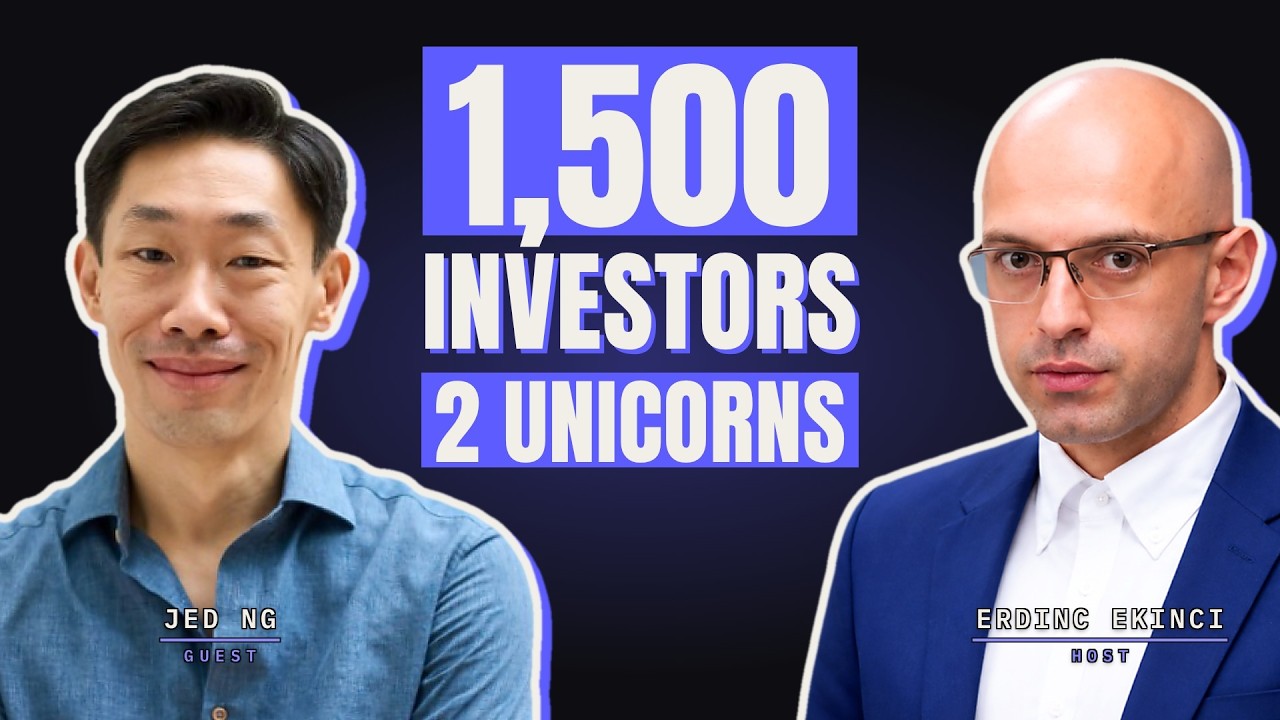
Jed Ng is a self-taught angel investor. He has gone seed to unicorn twice. He runs Angel School, an angel syndicate in Singapore with a network of 1,500 investors. And he runs it alone.
So when he says "don't start with a fund", it is worth stopping to listen. Here is what I took away.
Watch the full conversation
Chapters are in the YouTube description, so you can jump to the part you need.
A fund is a title. A syndicate is a start.
An angel syndicate is a group of angel investors who back startups together, one deal at a time. There is no blind pool of money sitting in a bank. Every investor decides on every deal.
A fund is the thing everyone dreams about. It also takes years before you write a single cheque.
"It could take two to three years for you to raise your first VC fund."
A syndicate can be live in a few months. Jed called it a 90% faster time to launch. That gap is the whole argument. Two to three years spent raising is two to three years not investing, not learning, and not building a record.
His conclusion is not that funds are bad. It is about order.
"It does make more sense to start with a syndicate, and then leapfrog to a fund."
The fees eat more than most people think
Jed walked through the math behind each structure, and one number stuck with me.
In a typical fund, the manager charges a yearly fee on the money raised. Over a ten year fund life, that adds up.
"20% of your capital goes towards management fees, 80% gets deployed."
So a fifth of what investors hand over never reaches a startup. In a syndicate the money goes into the deal, and the lead earns from the upside.
He was careful here, and I want to be too. He did not say one structure wins every time.
"There is no one better than the other."
His point is that a new investor should pick the structure that lets them start, prove judgement, and grow from there.
Every deal starts with a no
For anyone writing their first cheques, Jed shared his rules. The one I keep thinking about is how he opens every deal.
"Every deal for me starts with a no."
Then the founder and the data have to move him off it. "You actually need to build up conviction." Not the other way round, where you fall in love first and look for reasons later.
And when a deal gets away, he does not chase it.
"There will always be another deal."
He described himself as saying no 99.9% of the time. That is the discipline that keeps a syndicate's investors coming back.
I see the opposite in many new angels I meet through Openfor.co and Founder Institute programs. The first exciting pitch feels like the only one. It never is.
1,500 investors, one call at a time
This was the part of the conversation I wanted most, because building a network is where most would-be investors stall.
Jed's network did not come from an event or a mailing list. It came from meeting people. He spends about 30 minutes with every investor before they see his deal flow.
"I have 150 people requesting access to my deal flow, because I haven't met them yet."
That sounds slow. It is slow. It is also why the network works. When he says "which door do you need me to open for you", he can mean it, because he knows who is behind each door.
After 15 years of selling across Japan, I recognise this pattern. Trust does not scale through broadcast. It scales through a lot of small, real conversations that compound.
Is venture capital dead? Not dead. Crowded.
I asked him straight out. There was a long pause before he answered.
"I think that there are too many fund managers in the market and the world cannot sustain it."
He also pushed back on a popular idea: that emerging fund managers outperform experienced ones. From a data perspective, he called that narrative "fundamentally wrong", and added a line that says a lot about how the industry really works.
"Your first fund is the best fund. Everything else is downhill."
I will be honest. I have been on the other side of this. I told him in the session that, looking back, I should have started with a syndicate too. Hearing his math made that confession easier, not harder.
The one-person company is a design choice
Here is the line that stopped me.
"You are looking at the entire team. I have nobody working for me."
He runs the whole operation on about $60 a month of tech and tools. No staff, no office, no outside funding.
What surprised me more was what people assume from the outside.
"They think we're a 50-person organization."
It is just Jed at home. The content, the brand and the systems do the work a team would normally do. And he did not start out good at this. He told me marketing and brand building is his weakest skill set, and that early on he thought he was a disaster at it.
This is the exact shift I talk about with founders in Japan, Korea and Taiwan who can build anything but freeze when it is time to be visible. Jed is proof that the weak skill can be learned, and that one person with the right tools can look like a firm.
Angel investing is still too small
Jed believes angel investing is nowhere near the size it should be.
"I guarantee you it is like 10 times lower than what it should be."
More people could be backing founders early. Many do not, because the path looks closed, slow and expensive. A syndicate is one of the ways that path opens up.
His worst deal, and his best
I always ask guests for a loss, because the losses teach more.
Jed's worst deal was an AI audiobook startup. "The company didn't work out." He put the failure down to two things he overlooked, one of them being how regulation and AI policy can choke off a market.
Then the other side.
"I invested in Turing.com at seed stage when the company was $15 million valuation."
The company later raised its Series E at a $2.2 billion valuation. He did not tell it as a victory lap. He told it as a lesson in what early conviction looks like when you get it right, and he was clear it was a story, not a promise.
The mindset is the same on both sides
At the end, Jed said the line I would put on the wall of every program I run.
"The investor mindset and the entrepreneur mindset are one and the same."
Start small. Prove it. Then go bigger. That works for a startup, and it turns out it works for a fund too.
Watch the full session
This is the short version. The full conversation runs just under an hour and ends with his worst deal and his best.
Watch the full episode on YouTube
Subscribe for more conversations with the founders, investors and operators building globally.
About Angel School: A Singapore-based angel syndicate founded and run by Jed Ng, with a network of 1,500 investors backing early-stage startups deal by deal. Jed's early investments include Turing.com.
About Openfor.co: Building alone? No team, no mentors, no audience, no one keeping you accountable. With a simple Openfor.co membership you get a whole company behind you: AI agents that do the work, mentors who review it with you every week, your own audience and distribution channel built around what you make, and a global community to test with, sell to and build with. openfor.co
This post is for education only and reflects the personal views of the speakers. It is not financial, legal or investment advice.